Roofing
Salt Air Roof Damage Coastal South Florida: Protect Your Home
Salt air roof damage in coastal South Florida is one of the leading causes of premature roof failure — here's the science behind it and how to stop it before it costs you thousands.
Reviewed by Aldo Dellamano, Licensed General Contractor · Last updated August 2026
What Is Salt Air Roof Damage in Coastal South Florida?
Salt air roof damage in coastal South Florida occurs when airborne sodium chloride particles — carried inland by ocean breezes up to 10 miles from the shoreline —…
Salt air roof damage in coastal South Florida occurs when airborne sodium chloride particles — carried inland by ocean breezes up to 10 miles from the shoreline — land on roofing surfaces and begin a sustained electrochemical attack. In Miami-Dade and Broward counties, the Florida Building Code classifies coastal zones as High-Velocity Hurricane Zones (HVHZ), where wind-driven salt spray is treated as a design load, not an afterthought. The damage mechanism works in 3 stages: first, salt deposits accumulate on metal components like fasteners, flashing, and drip edges; second, moisture from South Florida's 60+ annual inches of rainfall activates the salt, triggering rapid oxidation; third, the corrosion expands, breaking the seal between roofing layers and allowing water intrusion. Asphalt shingles suffer a parallel degradation path — salt accelerates the breakdown of the petroleum-based coating, causing granule loss 2–3 times faster than in inland areas. Once granules are gone, UV radiation from South Florida's intense sun finishes the job.
- 10 miles
- Inland salt spray reach
- 2–3×
- Faster granule loss
- 60+
- Annual inches of rainfall
- Under 3%
- Haven's warranty callback rate
How Salt Corrodes Every Layer of Your Roof
30+ years of South Florida roofing experience reveals a consistent failure pattern: the metal components go first.
30+ years of South Florida roofing experience reveals a consistent failure pattern: the metal components go first. Standard galvanized steel fasteners, which are acceptable in inland Florida, begin surface rust within 3–5 years in coastal environments. As the zinc coating corrodes, the underlying steel expands slightly — enough to crack the shingle or tile it was anchoring. That crack becomes a water entry point. Flashing — the thin metal strips sealing joints around chimneys, vents, and skylights — suffers the same fate. Galvanized flashing in a Miami Beach or Fort Lauderdale home can develop pinhole leaks in as few as 7 years. Aluminum and stainless steel flashing, by contrast, resists chloride-induced oxidation dramatically better and can last 25–40 years in the same environment. Beyond the metal, salt also disrupts the bond between roofing underlayment and decking by wicking moisture into seams. This is why a coastal home in Boca Raton with a 12-year-old roof may already show the structural fatigue typical of an 18-year-old roof in Orlando.
Salt air roof damage in coastal South Florida can cut a standard 25-year asphalt shingle roof's functional lifespan down to 15 years — without a single hurricane. Coastal homeowners need to adjust their inspection schedules and material choices accordingly.
The Algae and Mildew Problem: Salt Air Makes It Worse
Algae and mildew growth on shingles is a recognized problem across Florida, but coastal salt air compounds it significantly.
Algae and mildew growth on shingles is a recognized problem across Florida, but coastal salt air compounds it significantly. Salt deposits on shingles create a hygroscopic (moisture-attracting) surface that stays damp longer after rain or morning humidity. That prolonged moisture creates ideal conditions for Gloeocapsa magma — the blue-green algae responsible for the dark streaks on asphalt roofs — to colonize. In Coral Gables and Hollywood, Haven crews regularly inspect roofs where algae has consumed 30–40% of the shingle surface within just 8 years of installation. Beyond aesthetics, algae degrades the shingle's reflective granules, raising attic temperatures by as much as 15°F and increasing cooling costs. Mildew penetrates deeper, breaking down the fiberglass mat inside the shingle. Copper- or zinc-impregnated shingles can slow algae growth, but in coastal South Florida the salt load is heavy enough that even treated shingles benefit from professional cleaning every 2–3 years. For a full breakdown of how long different roofing materials last in Florida's climate, see our guide on how long a roof lasts in Florida.
Warning Signs of Salt Air Roof Damage
- Rust stains on fascia — Orange or brown streaking below the roofline signals corroded fasteners or flashing — a leading indicator that salt has compromised your roof's metal components.
- Granule buildup in gutters — Finding significant asphalt granules in your gutters after routine rain — not just after a major storm — means salt is accelerating shingle coating breakdown.
- Dark algae streaks — Vertical dark streaks running down shingles indicate Gloeocapsa magma colonization, which thrives on salt-dampened surfaces and weakens shingles from the outside in.
- Lifted or loose flashing — Flashing that has visibly separated from the roof surface has likely lost adhesion due to corrosion-driven expansion — a common salt air failure point around chimneys and skylights.
- Bubbling or blistering shingles — Salt-accelerated granule loss exposes the asphalt layer to direct UV, causing it to bubble. Blistering shingles in coastal areas often indicate a roof nearing the end of its functional life.
Best Roofing Materials for Coastal Salt Air Environments
Choosing the right material is the single most impactful decision a coastal homeowner can make against salt air roof damage in coastal South Florida.
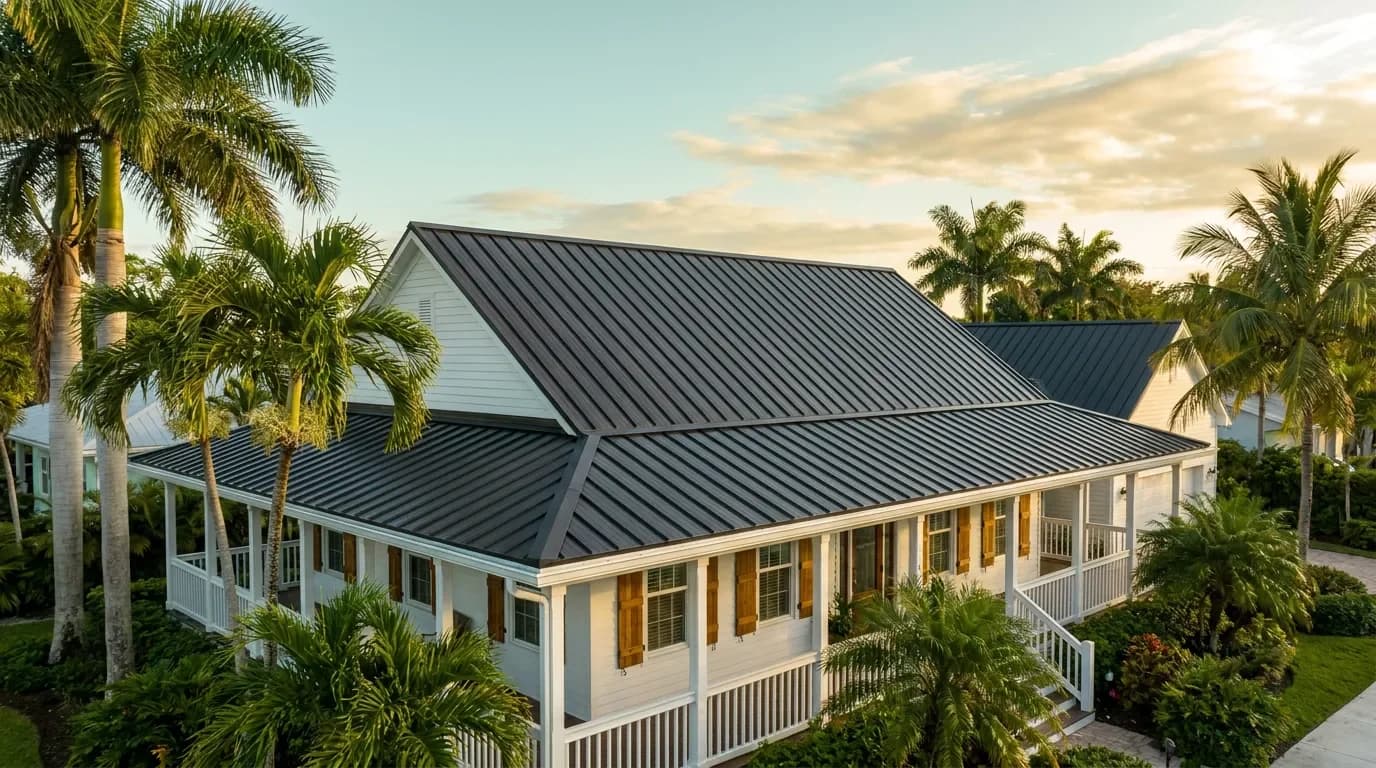
Choosing the right material is the single most impactful decision a coastal homeowner can make against salt air roof damage in coastal South Florida. Metal roofing — specifically aluminum and Galvalume (zinc-aluminum alloy coated steel) — leads the category for corrosion resistance. Aluminum does not rust, period. It forms a natural oxide layer that actually blocks further salt penetration. Galvalume steel offers similar protection at a lower price point and carries Miami-Dade Notice of Acceptance (NOA) approval for HVHZ installation. Metal roofing panels installed with stainless steel or aluminum fasteners — never standard galvanized — can realistically last 40–50 years on a South Florida coastal home. Concrete and clay tile are also excellent choices because they contain no metal in the field panel itself, though their fasteners and underlayment systems must still be specified for salt exposure. The Miami-Dade NOA database lists every approved material, system, and fastener combination — always verify your contractor is pulling from it. Asphalt shingles can work in coastal zones, but require algae-resistant, copper-infused products rated for high-humidity environments, and the inspection cycle must be shortened to every 2 years.
Roofing Materials: Coastal Performance Comparison
| Coastal Performance | Inland Florida | |
|---|---|---|
| Aluminum Metal Roof | 40–50 yr lifespan; no rust; best for salt zones | 40–50 yr lifespan; same performance inland |
| Galvalume Steel Roof | 30–45 yr lifespan; zinc-aluminum barrier resists salt | 35–50 yr lifespan; slightly longer inland |
| Concrete / Clay Tile | 25–35 yr lifespan; corrosion-free panels; fasteners critical | 30–40 yr lifespan; same tile, less fastener stress |
| Asphalt Shingles | 12–18 yr effective lifespan; salt accelerates granule loss | 20–25 yr lifespan; standard performance |
| Standard Galvanized Steel | NOT recommended; rust failure in 3–7 yrs near coast | Acceptable; 15–20 yr lifespan inland |
Haven's warranty callback rate sits under 3% — a direct outcome of the dedicated-crew model and 30+ years of South Florida experience behind every project. That number matters on the coast, where improper fastener selection alone can void a manufacturer's warranty.
How to Protect Your Coastal Roof: A 5-Step Action Plan
- Schedule a coastal-specific inspection — Inland inspection cycles of every 5 years are not adequate for salt-air zones. Coastal homeowners in Miami-Dade, Broward, Palm Beach, and St. Lucie counties should have a professional inspection every 2 years — or annually if the roof is over 10 years old.
- Upgrade fasteners and flashing immediately — If your current roof uses standard galvanized fasteners or flashing, ask your roofer about a targeted replacement with stainless steel or aluminum components. This targeted upgrade can add 5–8 years of functional life to an otherwise sound roof at a fraction of the cost of full replacement.
- Apply a protective roof coating — Elastomeric and acrylic roof coatings create a sealed membrane over existing roofing that blocks salt penetration and reflects UV. Coatings are especially effective on flat and low-slope roofs common on South Florida commercial and residential buildings — and they qualify for Energy Star cool roof credits.
- Clean algae and salt deposits proactively — Low-pressure soft washing with a biodegradable, roof-safe detergent removes salt deposits and algae colonies before they penetrate shingle layers. Do not use high-pressure washing — it strips granules and voids most manufacturer warranties. Schedule cleaning every 2–3 years minimum.
- Plan your next roof with coastal materials — When replacement time comes, choose aluminum or Galvalume metal panels, or NOA-approved tile systems with stainless fasteners. Review your contractor's material specs against the Florida Building Code HVHZ requirements before signing. This is the single decision that determines whether your next roof lasts 20 years or 45 years.
Haven Serves the Full South Florida Coastline
Salt air roof damage in coastal South Florida is a challenge Haven crews encounter on every job from Miami to Jensen Beach.
Salt air roof damage in coastal South Florida is a challenge Haven crews encounter on every job from Miami to Jensen Beach. Haven's roofing services cover the entire South Florida coastline — West Palm Beach, Delray Beach, Port St. Lucie, and Boynton Beach in the north; Fort Lauderdale, Hollywood, and Coral Gables in the center; and Miami Beach, Aventura, and Homestead in the south. Every crew is dedicated to Haven — long-tenured teams that work almost exclusively on Haven projects — which means the same experienced team handles your project from permit to final inspection. That consistency is what keeps Haven's warranty callback rate under 3%, even on the most corrosion-demanding coastal projects. When evaluating contractors, always verify licensure at myfloridalicense.com and confirm their material specs include NOA-approved fasteners for your coastal zone. For help choosing the right system, our guide on what is the best roofing material walks through the full comparison for South Florida conditions.
Every roofing material selection on a coastal South Florida home should be cross-referenced against the Miami-Dade NOA database. If a product doesn't have HVHZ approval, it doesn't belong on a home within 10 miles of the Atlantic or Gulf coast.
About the Author
Aldo Dellamano
Licensed General Contractor · Haven Home Remodeling Group
Aldo Dellamano is a licensed Florida General Contractor with over 30 years of experience in South Florida roofing and bathroom remodeling. He leads Haven’s dedicated crews across Miami-Dade, Broward, Palm Beach, Martin, and St. Lucie counties, where his team completes more than 1,200 projects per year. Aldo serves as the technical reviewer for every guide, city page, and FAQ published on havenhrg.com, with a focus on HVHZ wind-uplift compliance, Miami-Dade NOA-approved materials, and the permit process that determines whether a homeowner’s insurance claim gets paid.
Florida State Credentials
- #CGC1532033 (General Contractor)
- #CCC1336241 (Roofing Contractor)
- #CFC1434398 (Plumbing Contractor)
- #CMC1251666 (Mechanical Contractor)
Free Roofing Estimate
Ready to talk through your roof?
Tell us about your home and project. We'll get back to you within 24 hours with a free, no-obligation estimate from our licensed Florida roofing crew.
- Licensed & Insured FL Contractor
- Dedicated crews, start to finish
- Free, no-obligation estimate
- We respond within 24 hours
A Safeguard Impact company
Get Your Free Estimate
No obligation. We'll respond within 24 hours.
Common Questions
Frequently Asked Questions
Sources & References
External authorities cited in this article. Verify the latest published version of any building code or product approval directly with the issuing agency.
From the Blog
Continue Reading
Roofing
Tile Roof Installation in South Florida: What to Know Before You Buy
Tile roof installation in South Florida: compare concrete vs clay, wind ratings, cost, and HVHZ code requirements before you buy.
Read articleRoofing
Roof Insurance Claim After a Hurricane: Florida Homeowner's Guide
Filing a roof insurance claim after a hurricane in Florida? Follow these steps to document damage, work with adjusters, and avoid costly claim.
Read articleRoofing
Shingle Roofing in South Florida: Complete Homeowner Guide
Everything South Florida homeowners need to know about shingle roofing — costs, codes, permits, contractor tips, and local climate considerations.
Read articleRoofing
HVHZ Roofing Requirements Florida: What Every Homeowner Must Know
HVHZ roofing requirements Florida homeowners must know — NOA materials, six-nail patterns, and why non-compliance voids your insurance.
Read articleContent Disclosure
This article is provided for general information only and reflects current Florida Building Code requirements, common South Florida construction practices, and Haven's field experience. Actual project costs, permit requirements, material availability, and timelines vary based on your home, municipality, and project scope. Florida law requires that any residential construction work over $1,000 be performed by a licensed contractor — always consult a Florida-licensed contractor before starting a roofing or bathroom remodel and verify credentials at myfloridalicense.com. This guidance is not a substitute for a project-specific estimate or on-site evaluation by a licensed professional.