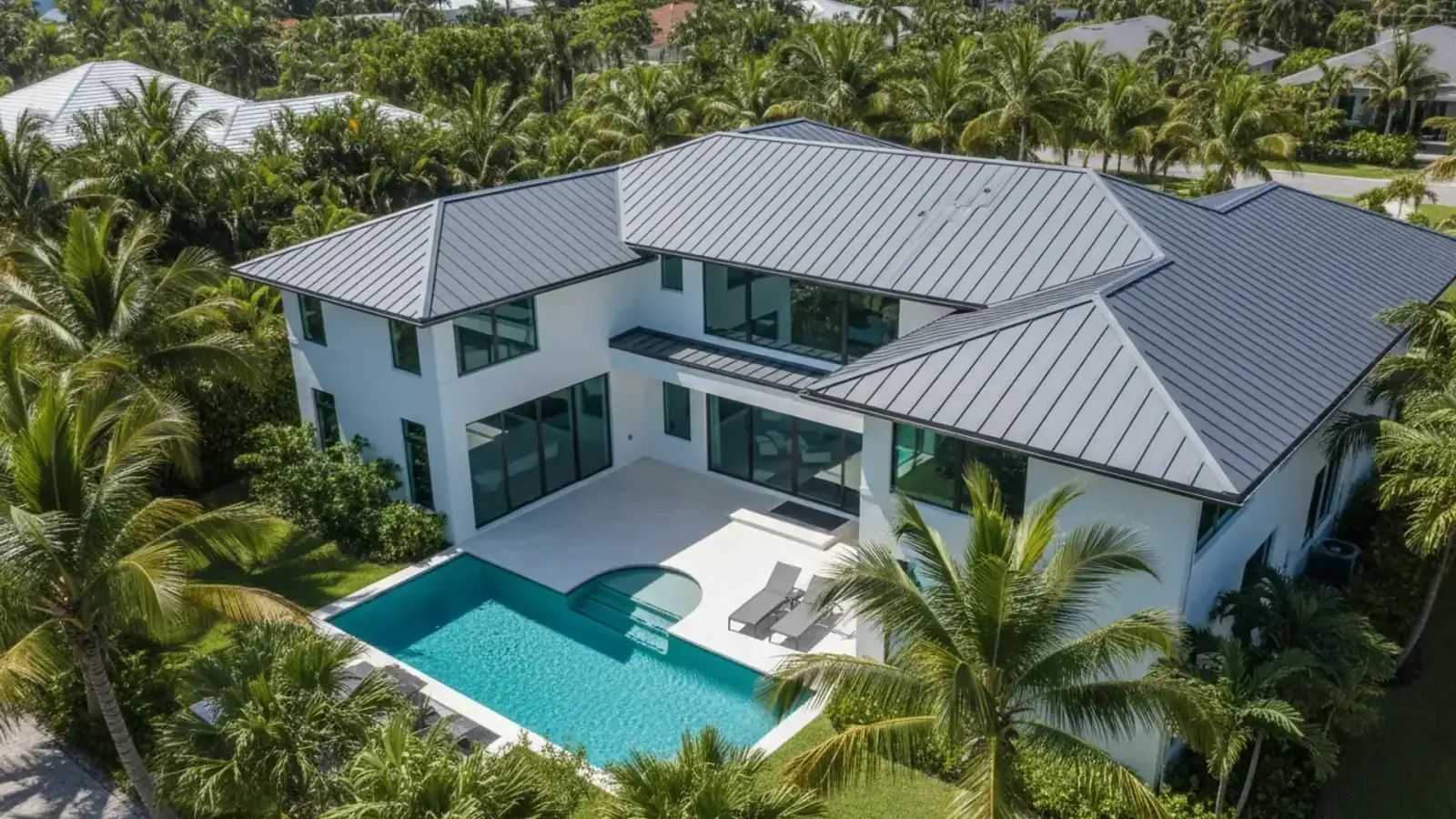
Roofing · Tile Replacement
Tile Roof Replacement in South Florida
Concrete and clay tile tear-off and reinstallation built for 50+ years in South Florida
A Safeguard Impact company — licensed South Florida contractor with 1,200+ projects completed each year
Get Your Free Estimate
No obligation. We'll respond within 24 hours.
Reviewed by Aldo Dellamano, Licensed General Contractor · Last updated April 2026
Introduction
Tile roof replacement is the most common large-scale project we handle across Miami-Dade, Broward, and Palm Beach counties. Concrete and clay tile systems dominate South Florida homes — and for good reason. They shed heat, resist salt air, and can outlast the house itself when installed correctly.
But a tile roof is only as good as what sits underneath it. Underlayment, hurricane clips, and frame reinforcement matter just as much as the tile on top. Haven Home Remodeling Group gives you all of it: full tear-off, code-compliant substrate work, and NOA-approved tile set by our own in-house crews.
No subcontractors. No shortcuts. This guide covers everything you need to know before you sign a contract.
Got questions about your roof or bathroom?
Get a free, no-pressure estimate from Haven's licensed Florida team.
South Florida tile roof replacement must meet the Florida Building Code — and in Miami-Dade and Broward counties, those rules tighten under the High Velocity Hurricane Zone (HVHZ) standard. Every tile product used on an HVHZ job must carry a Miami-Dade Notice of Acceptance (NOA). That approval means the tile has been wind-tunnel tested and load-tested to survive 175+ mph gusts. A tile without an NOA cannot be legally installed here — full stop.
The subtropical climate adds more pressure. UV exposure degrades underlayment faster here than in most of the country. Salt air on the coast corrodes metal flashings and fasteners. And the wet season dumps six-plus months of heavy rain every year. Each of these factors shapes how we select products and detail the install.
“That approval means the tile has been wind-tunnel tested and load-tested to survive 175+ mph gusts.”
Our Roofing work spans the full range of South Florida systems. Tile is the most demanding. It weighs more, costs more to remove, and needs more frame prep than any other material. Get it right the first time and it lasts 50 years. Get it wrong and you're dealing with cracked tiles, leaks, and permit violations after the first hurricane.
What You Get
Tile Types: What South Florida Homeowners Actually Install
Barrel tile (S-tile)
The most common profile in South Florida. A curved S-shape that channels water away fast. Available in both concrete and clay. Standard on most older homes in Coral Gables and Coconut Grove.
Flat tile
A low-profile option popular in modern and Mediterranean-style builds. Lighter than barrel tile. Common in newer Doral and Kendall subdivisions.
Concrete tile
Weighs about 9 to 11 pounds per square foot. More affordable than clay. Holds paint well and comes in a wide range of colors. The workhorse of South Florida tile replacement.
Clay tile
Weighs slightly less than concrete — about 7 to 9 pounds per square foot. More expensive upfront but never needs repainting. Color is baked in during firing and lasts the life of the tile.
Color-matched replacement tile
When replacing a partial section, color matching is critical. Tile color fades over time. We source from the same manufacturer batch when possible or weather-match from salvage stock.
Tile Weight Is a Structural Issue — Not Just a Product Choice
Concrete and clay tile can weigh 900 to 1,100 pounds per square (100 sq ft). Before any tile roof replacement, we inspect your trusses and sheathing. Older homes may need extra framing work to carry the load safely.
The tile itself gets most of the attention. But what sits under it does more work. A proper tile roof replacement uses a two-layer underlayment system — typically a base sheet mechanically fastened to the deck, topped with a self-adhering modified bitumen cap sheet. In HVHZ zones, the Florida Building Code requires specific fastening patterns and underlayment ratings that vary by wind speed zone. We pull permits and schedule inspections at every phase to stay current.
Hurricane clips are the other critical piece. Each tile must be anchored to the batten or deck with code-approved clips or foam adhesive. Foam-set tile systems have become common in recent years. They pass NOA testing and reduce tile breakage during storms — but only when the foam is applied at the right bead size and spacing. Our crews are trained on both clip-set and foam-set systems.
“In HVHZ zones, the Florida Building Code requires specific fastening patterns and underlayment ratings that vary by wind speed zone.”
Flashings around chimneys, skylights, and walls must be replaced during a full tear-off. We use lead or galvanized metal — never caulk alone. Valleys get waterproof membrane before tile is laid. These details separate a 50-year roof from one that leaks in year eight.
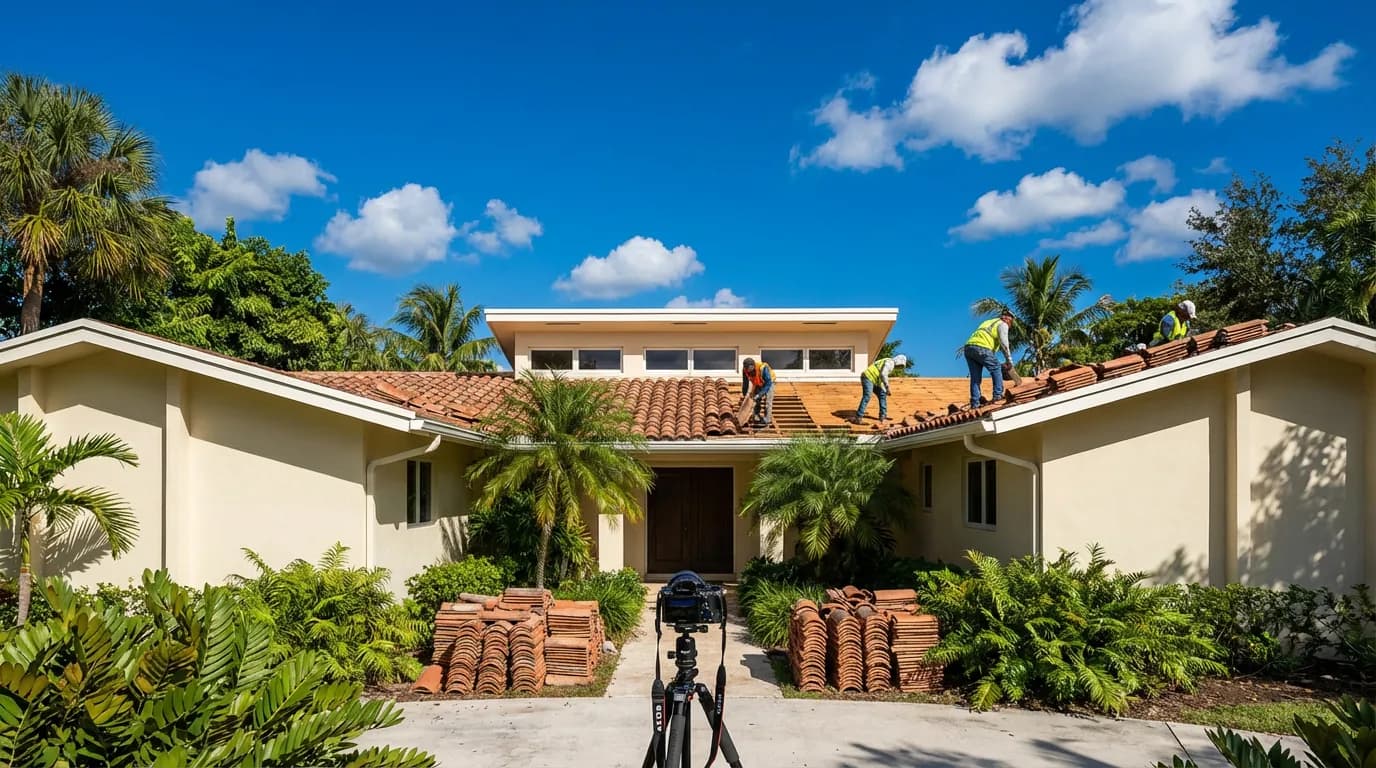
In the Field
Barrel tile tear-off before new underlayment install
Haven crew installing tile roof replacement materials on a Miami, FL home — detail of underlayment and fastener pattern
Side-by-Side
Concrete Tile vs. Clay Tile: Which Is Right for You?
| Feature | Concrete Tile | Clay Tile |
|---|---|---|
| Weight (per sq ft) | 9–11 lbs | 7–9 lbs |
| Upfront cost | Lower | Higher |
| Color longevity | Fades, needs repainting | Baked-in color, never fades |
| Lifespan | 30–50 years | 50–100 years |
| HVHZ NOA availability | Wide selection | Narrower selection, verify per product |
| Best for | Budget-focused tile replacement | Long-term, low-upkeep install |
Some markets allow roofing contractors to install new tile over existing tile — a process called overlay or recover. South Florida does not. The HVHZ rules under the Florida Building Code require a full tear-off on most tile roof replacement jobs. Adding a second layer of tile to an already-heavy frame creates a dangerous load. It also hides whatever is rotting underneath. We always do full tear-off — every layer of old tile, old underlayment, and damaged sheathing comes off before we start fresh.
Tear-off also lets us inspect the deck. We look for soft spots, rot, and truss damage. When we find it — and we often do in homes from the 1970s and 1980s — we repair it before the new system goes on. This is the only way to give a lifetime workmanship warranty and mean it.
“When we find it — and we often do in homes from the 1970s and 1980s — we repair it before the new system goes on.”
If you only have cracked or missing tiles with a solid deck underneath, you may not need a full replacement. Our Roof Repair service covers spot repairs and partial sections. For full systems past their service life, tile roof replacement is the right call. We also offer Roof Replacement for homeowners weighing tile against other systems.
Ready to talk to a real local expert?
Tell us about your project — we respond within 24 hours.
Process
The Tile Roof Replacement Process: Start to Finish
- 1
Free estimate and inspection
We inspect your deck, trusses, flashings, and existing tile. We measure the roof and check for frame issues. You get a detailed written quote — no surprise add-ons.
- 2
Permit pull and material order
Haven pulls the building permit with your local municipality. We order NOA-approved tile in your chosen profile and color. Lead times vary by product — we plan around them.
- 3
Full tear-off
Our crew removes all existing tile, underlayment, and damaged sheathing. We protect your landscaping and driveway with tarps and dump equipment. Job site is kept clean daily.
- 4
Deck prep and underlayment
We replace damaged sheathing and install the two-layer underlayment system required under HVHZ rules. Base sheet goes down first, then the cap sheet, fully adhered at laps and edges.
- 5
Tile installation and final inspection
Battens are set, then tile is laid using either clip-set or foam-set method per the NOA spec. Flashings are installed. We schedule the final city or county inspection and walk the roof with you on completion.
By the Numbers
Haven Tile Replacement by the Numbers
50+
Years tile lifespan
Clay tile can exceed 100 years with proper install
1,200+
Projects per year
Across roofing and bath remodeling in South Florida
1,500+
Permits pulled per year
Every tile replacement is fully permitted
<3%
Warranty callback rate
Backed by a lifetime workmanship warranty
We handle tile roof replacement across all of Miami-Dade County. In the historic neighborhoods of Coral Gables — Old Cutler, Riviera, Cocoplum — barrel tile is nearly universal. Many of these homes have original 1950s and 1960s tile that is decades past its service life. Miami Tile Replacement covers a wide range of builds in Brickell, Coconut Grove, and Wynwood. In Hialeah, we work across West Hialeah, East Hialeah, and the Hialeah Gardens area — a dense urban market where permit coordination and scheduling matter most.
Suburban Miami-Dade keeps us busy year-round. Kendall — The Hammocks, Kendale Lakes, Country Walk — is full of 1980s and 1990s concrete tile homes. Cutler Bay and Miami Lakes follow a similar profile. Doral is newer construction but not immune to underlayment failure after heavy storm seasons. North Miami neighborhoods like Keystone Point and Sans Souci Estates sit close to the water — salt air accelerates metal flashing decay there.
“In South Miami-Dade, Homestead sits in one of the most active wind-damage corridors in the state — Hurricane Andrew made landfall nearby in 1992.”
On the coast, Miami Beach and Aventura present unique challenges. Salt exposure is extreme. We use corrosion-resistant fasteners on every coastal job. In South Miami-Dade, Homestead sits in one of the most active wind-damage corridors in the state — Hurricane Andrew made landfall nearby in 1992. Every tile roof replacement we do there is built to handle whatever the National Hurricane Center tracks toward South Florida next.
Not sure what your project should cost?
Free, itemized estimates from Haven. No obligation, no sales pressure.
Tile Isn't the Only Option — We Do It All
If you're weighing tile against other systems, check out our Metal Roofing and Shingle Roofing pages. For impact-rated shingle tear-off, see our Shingle Roof Replacement guide. Storm damage after a hurricane? Our Storm Damage Restoration team handles emergency tarping and insurance claims.
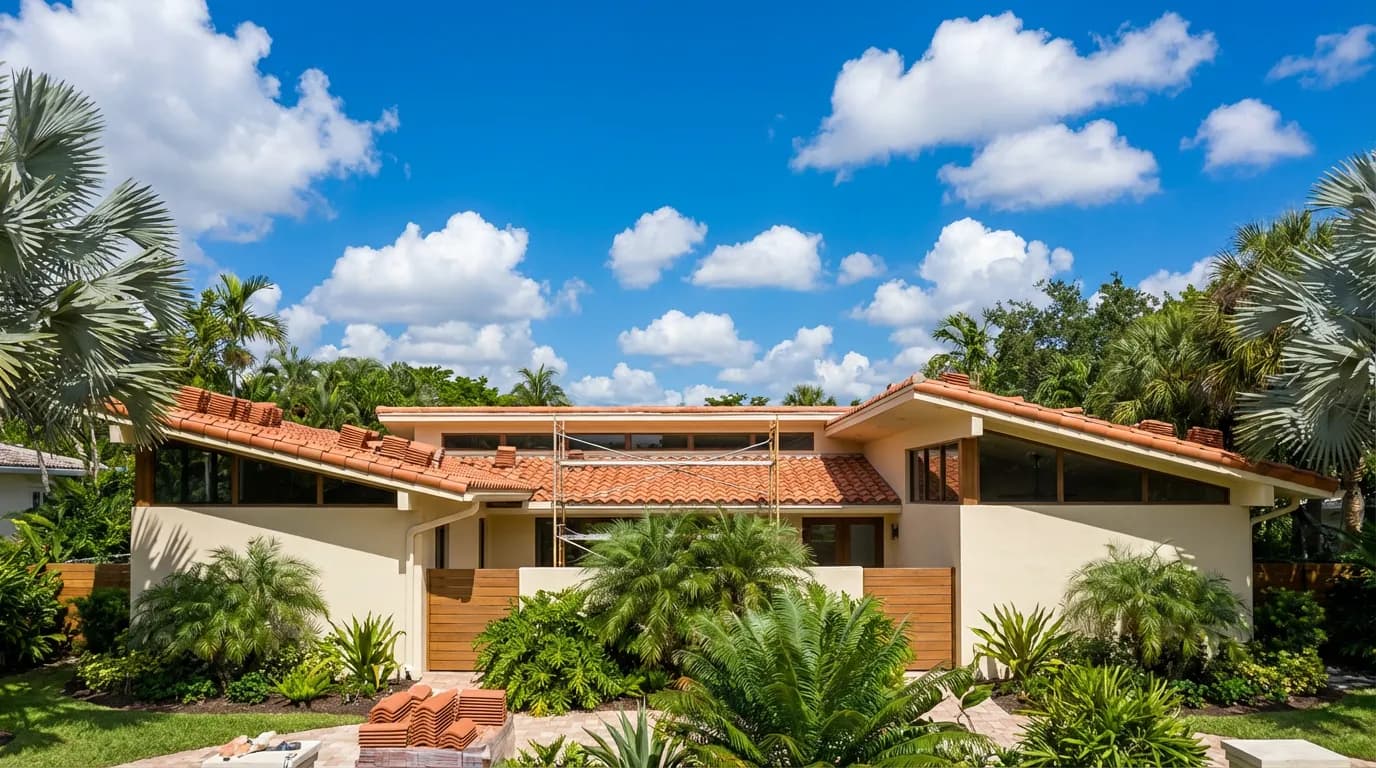
In the Field
Clay tile install — Coral Gables historic district
Clay tile install — Coral Gables historic district — Haven Bathrooms & Roofing, Miami, FL
Tile roof replacement is a big investment. The wrong crew can leave you with code violations, a voided manufacturer warranty, or a roof that fails in the next storm. Here's what to verify before you sign anything. First, confirm the contractor holds an active Florida state license. You can check any license at the DBPR website in under a minute. Haven is led by licensed general contractor Aldo Dellamano with over 30 years of South Florida construction skill behind every project.
Second, ask who is doing the work. Many firms bid the job and then hand it to day-labor crews they've never worked with before. Haven runs 20 full-time in-house crews. The same people who attended our training are on your roof. Third, ask about the underlayment spec. A one-layer underlayment system does not meet HVHZ rules on a tile roof. If a contractor proposes it, walk away.
“Haven is led by licensed general contractor Aldo Dellamano with over 30 years of South Florida construction skill behind every project.”
Fourth, ask to see the NOA for the tile they plan to install. Every product should have a current Miami-Dade or Florida Product Approval number on file. If they can't produce it, the tile is not code-legal in South Florida. These questions take five minutes and protect a 50-year investment.
Common Questions
Tile Roof Replacement FAQs
Helpful Reads
Roofing Guides for South Florida
Roofing
Tile Roof Installation in South Florida: What to Know Before You Buy
Tile roof installation in South Florida is a long-term investment that demands the right material, structure, and code knowledge — here's the complete buyer's guide.
Read articleRoofing
Roof Insurance Claim After a Hurricane: Florida Homeowner's Guide
Filing a roof insurance claim after a hurricane in Florida is stressful — but knowing the right steps protects your payout and your home. Here's exactly what to do.
Read articleRoofing
Salt Air Roof Damage Coastal South Florida: Protect Your Home
Salt air roof damage in coastal South Florida is one of the leading causes of premature roof failure — here's the science behind it and how to stop it before it costs you thousands.
Read articleContent Disclosure
This article is provided for general information only and reflects current Florida Building Code requirements, common South Florida construction practices, and Haven's field experience. Actual project costs, permit requirements, material availability, and timelines vary based on your home, municipality, and project scope. Florida law requires that any residential construction work over $1,000 be performed by a licensed contractor — always consult a Florida-licensed contractor before starting a roofing or bathroom remodel and verify credentials at myfloridalicense.com. This guidance is not a substitute for a project-specific estimate or on-site evaluation by a licensed professional.